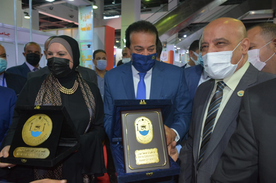
Under the auspices of Prof. Louai Saadeddin Nasrat-Acting of Aswan University President, Prof. Tarek Hassan Muhammad-Dean of the Faculty, Aswan University, Faculty of Energy Engineering in Aswan University organized activities of graduation project discussion for the academic year 2024/2025, in participation of Energy experts, university leaders, representors of huge social and industrial institutions, vice-deans, academic staff and their assistants, and students.
In his speech, Prof. Louai Saad El-Din pointed out his proudness of the distinguished level of students’ graduation projects, Aswan University in front of a new generation of engineers have the ability to transfer thoughts to effective applied models; electrical car project which designed by faculty’s students inside the university laboratories confirmed that Aswan University has confident steps towards supporting cleaning energy and localization modern technology.
Dr. Tarek Hassan stated that this year’s project students exemplify the faculty’s vision of preparing engineers to make change and lead the transition in Egypt’s energy field; he also stated that the faculty relies not only on theoretical education but also on practical and research application to serve “Sustainable Development Goals.”
Dr. Ashraf Imam, Vice-University President for Community Service and Environmental Development Affairs, added that these projects represented a tangible step toward serving the community and the surrounding environment, as well as demonstrating the university’s ability to connect engineering education with developmental realities.
Dr. Abdul-Momen Abdul-Rahim, Vice-Dean for Education and Student Affairs, stated that the faculty’s future vision includes expanding qualitative engineering programs such as petroleum engineering, natural gas, construction administration, and projects that align with strategic shifts in the Egyptian and global labor markets.
Dr. Mohamed Fathy, Vice-Dean for Postgraduate Studies and Research Affairs, stated that Aswan University’s Faculty of Energy Engineering is divided into two sections: electrical engineering and mechanical engineering, and that it offers specialized programs in the fields of renewable energy, electrical power, and applying mechanisms, as well as aspires to be a scientific lighthouse in Upper Egypt.
Among the highlights of the event was the Electric Car Project, a comprehensive practical experiment. An electric vehicle was manufactured in the college’s laboratories and subjected to practical testing on campus, demonstrating engineering readiness and innovation capabilities. The Smart City Project was also a practical model implemented in the seminar hall using Sonoff devices to intelligently control lighting, air conditioning, and fans via mobile applications and Alexa. The project achieved a 66.67% reduction in electricity consumption, at a total cost of no more than EGP 30,000, in a smart and economical experiment.
The Solar Still Project was also presented under the supervision of a select group of professors. The design of a low-cost cylindrical solar still for desalinating water without electricity was presented. It is ideally suited for remote environments and relies solely on solar energy, enhancing water security in desert areas. The Solar Power Tower Project was also presented, an integrated design that collects sunlight through reflective mirrors and focuses it on a heating point to produce steam used to generate electricity, as part of the move toward clean and sustainable energy.