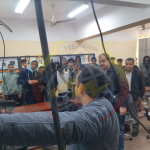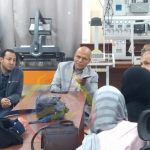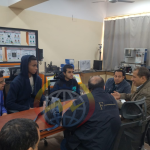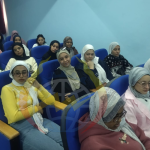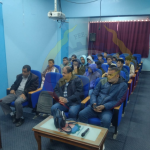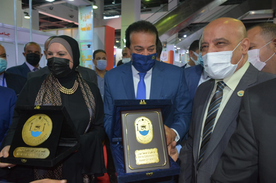
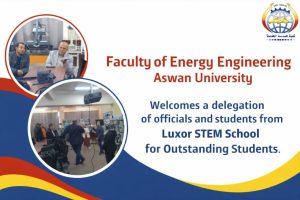
On Monday morning, March 2, 2026, Prof. Tarek Hassan Mohamed, Dean of the Faculty of Energy Engineering at Aswan University, and Prof. Ahmed Mostafa Owais, Head of the Electrical Engineering Department and Director of the TAICO Unit at the university, welcomed a delegation of students and officials from Luxor STEM School for Outstanding Students.
This school is considered one of the advanced governmental scientific schools that aim to develop research and innovation skills. It was established to serve students in Upper Egypt and targets scientifically talented students through an educational system based on scientific research and applied projects. The school is equipped with modern classrooms and innovation laboratories, including robotics, hydraulics, physics, chemistry, biology, geology, and language labs, with the aim of graduating scientists and engineers capable of competing globally.
The Dean of the Faculty delivered a presentation on the different types and sources of energy. These include new and renewable energy, which covers the study of solar energy, wind energy, geothermal energy, and biomass energy. It also includes hydropower, which involves the study of wave energy, tidal energy, and hydroelectric power plants. In addition, conventional energy was discussed, including thermal power plant engineering, fossil fuels, and natural gas, as well as nuclear energy, which focuses on nuclear materials and their applications in power generation. Furthermore, future energy and smart grids were highlighted, including smart energy networks, green hydrogen, and fuel cells.
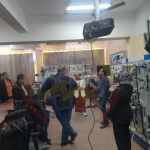
Engineer Ahmed Saleh Awad, Assistant Lecturer in the Electrical Engineering Department, also provided an explanation of the equipment in the Renewable Energy Laboratory at the faculty. The lab includes advanced devices used for training in solar energy, wind energy, and hydrogen technologies. It features solar panels, wind turbines, energy storage systems, environmental condition simulators, and efficiency measurement devices.
The Renewable and Sustainable Energy Engineering Program serves as a link between several engineering disciplines involved in designing, installing, operating, and maintaining renewable energy systems. These disciplines include electrical engineering, mechanical engineering, control engineering, environmental engineering, materials engineering, and other related engineering sciences.
At the end of the visit, a team including the Dean of the Faculty, the Director of TAICO, and Eng. Ahmed Saleh Awad participated in discussing the students’ proposed projects and answering their questions.